From Idea to Launch: The SaaS Development Timeline Explained
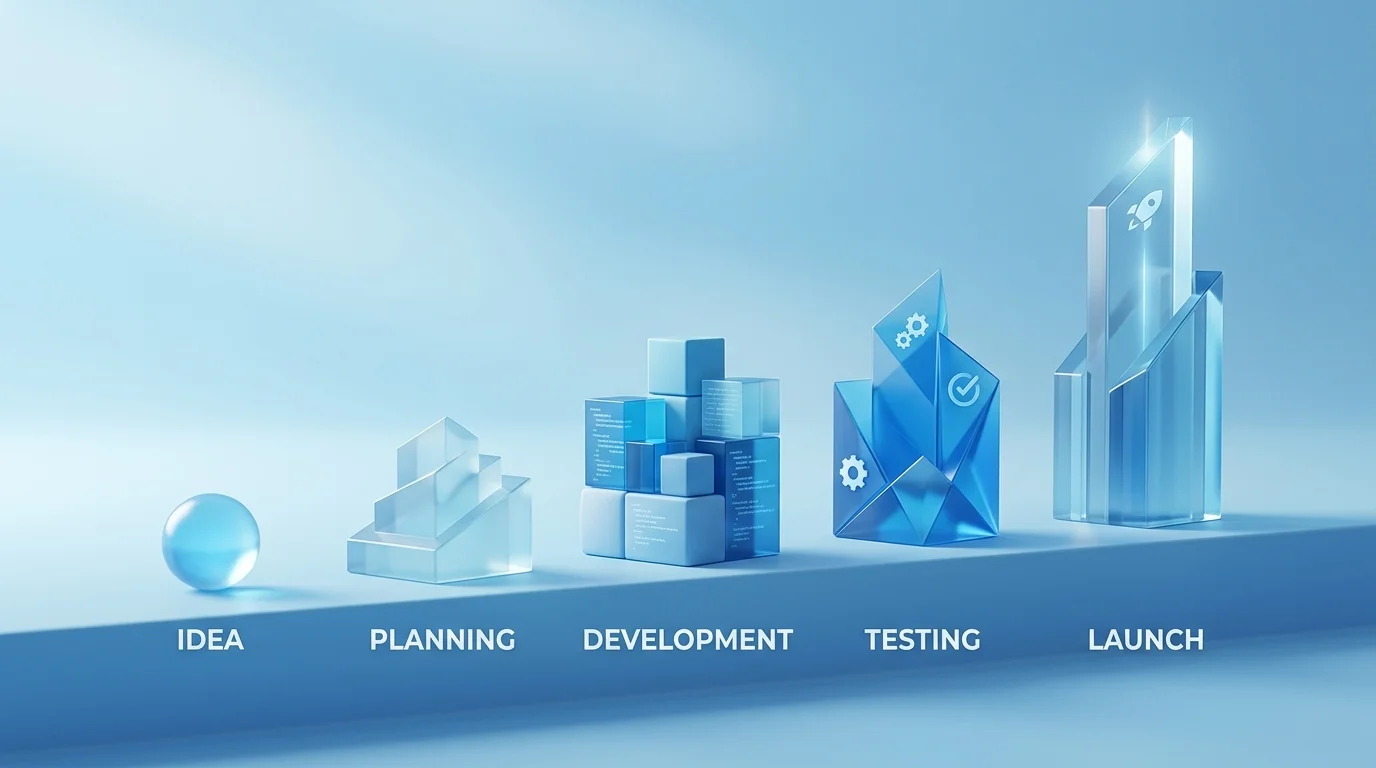
The timeline question everyone wants answered
"How long will it take?" is one of the first questions any founder asks when scoping a SaaS project, and it is one of the hardest to answer honestly. Too many agencies give optimistic estimates that make the project sound feasible and then quietly extend the timeline once work begins. We are going to give you a realistic picture instead.
The honest answer is that it depends — primarily on scope, team size, and how quickly you can make decisions. But we can give you realistic ranges for each phase of a typical SaaS build, and explain what drives the variation.
Phase 1: Discovery and scoping (2–4 weeks)
Before any development begins, you need a clear and agreed scope. This phase involves understanding your users, mapping the core user flows, making architectural decisions, and producing a prioritised list of features for the MVP.
Two weeks is realistic if you are decisive and well-prepared. Four weeks is more typical if you have multiple stakeholders with differing opinions, complex requirements that need research, or if the agency needs time to produce detailed wireframes before development begins.
Skipping or rushing this phase is the single most common cause of projects running over time and over budget. The time you invest here directly reduces surprises later.
Phase 2: Design (3–6 weeks, often overlapping with development)
If you need UX and UI design, this typically runs in parallel with early development. The design process includes wireframes, user testing of key flows, and high-fidelity mockups that the development team can build against.
Three weeks is achievable for a well-scoped MVP with clear user flows. Six weeks is more realistic if you have a complex product with many different user roles or if user research reveals that your initial assumptions need revision.
Many SaaS products attempt to skip design to save time. This almost always costs more time later when users find the product confusing and you have to redesign flows on top of existing code.
Phase 3: Core development (8–16 weeks for an MVP)
This is where the actual building happens. For a properly-scoped SaaS MVP, 8–12 weeks of active development is a realistic target with an experienced team. Complex products — multi-sided marketplaces, platforms with extensive integrations, or products with unusual technical requirements — can take 16 weeks or more even for an MVP.
What the core development phase typically includes:
- Authentication and user management
- Core data models and database schema
- Backend API development
- Frontend application
- Subscription and billing integration
- Core workflow features (the main value the product delivers)
- Basic admin tooling
- Infrastructure and deployment setup
Development time scales roughly with the number of distinct features, the complexity of integrations, and the number of user roles that need different experiences. Each integration — payment providers, email services, third-party APIs — adds time beyond the initial estimate.
Phase 4: Testing and QA (2–4 weeks)
Proper testing takes time, and it cannot be compressed indefinitely without consequences. This phase covers automated test writing, manual exploratory testing, bug fixing, and performance testing under realistic load.
Two weeks is realistic for a focused MVP with a limited feature set. Four weeks is appropriate for a larger product or one where reliability is critical — for example, anything handling financial transactions or sensitive personal data.
Teams that skip proper QA typically spend the first weeks after launch firefighting bugs instead of iterating on the product based on user feedback. That is an expensive tradeoff.
Phase 5: Soft launch and iteration (2–4 weeks)
A soft launch — making the product available to a limited group of early adopters before a full public launch — is genuinely valuable and should be built into the timeline. Real users will find issues that your team did not find in testing. Fixing those issues before a public launch is much better than dealing with them after.
Use this phase to gather feedback, fix critical issues, and make small improvements to onboarding and key flows. Do not try to add new features during a soft launch period — focus on making what you have work well.
Total timeline: what to realistically expect
Adding up these phases:
- A focused MVP with clear requirements: 16–20 weeks from start to public launch
- A more complex MVP with multiple integrations or user roles: 24–32 weeks
- A full-featured SaaS platform (not just an MVP): 9–18 months
These are realistic numbers. If an agency tells you they can deliver your SaaS MVP in six weeks, either the scope is extremely narrow, they are very optimistic, or they are telling you what you want to hear.
What delays projects most
In our experience, the most common causes of timeline slippage are:
- Scope creep: Features that were "out of scope" get added during development
- Slow client decision-making: Waiting for feedback or approvals from stakeholders stalls development
- Requirement changes: Discovering during development that the original requirements were wrong
- Integration complexity: Third-party APIs behaving differently than documented
- Underestimated complexity: Features that seemed simple turning out to be harder than expected
The first two are within your control as the client. Staying decisive, providing feedback quickly, and holding the scope firm during the build are the most valuable things you can do to keep a project on track.
How to plan realistically
Take whatever timeline you are given and add a 20% buffer. Not because the agency is necessarily being dishonest — software development is genuinely hard to estimate precisely — but because unexpected complexity is the norm, not the exception.
Plan your launch activities, fundraising conversations, and marketing campaigns around the later end of the expected range. It is much better to launch earlier than planned than to have to push back commitments you have already made.
Want a realistic timeline for your own project? Our SaaS developers UK team gives a written estimate after a single scoping call — no vague ranges.
 Custom SaaS Development
 Web App Development
 API Development