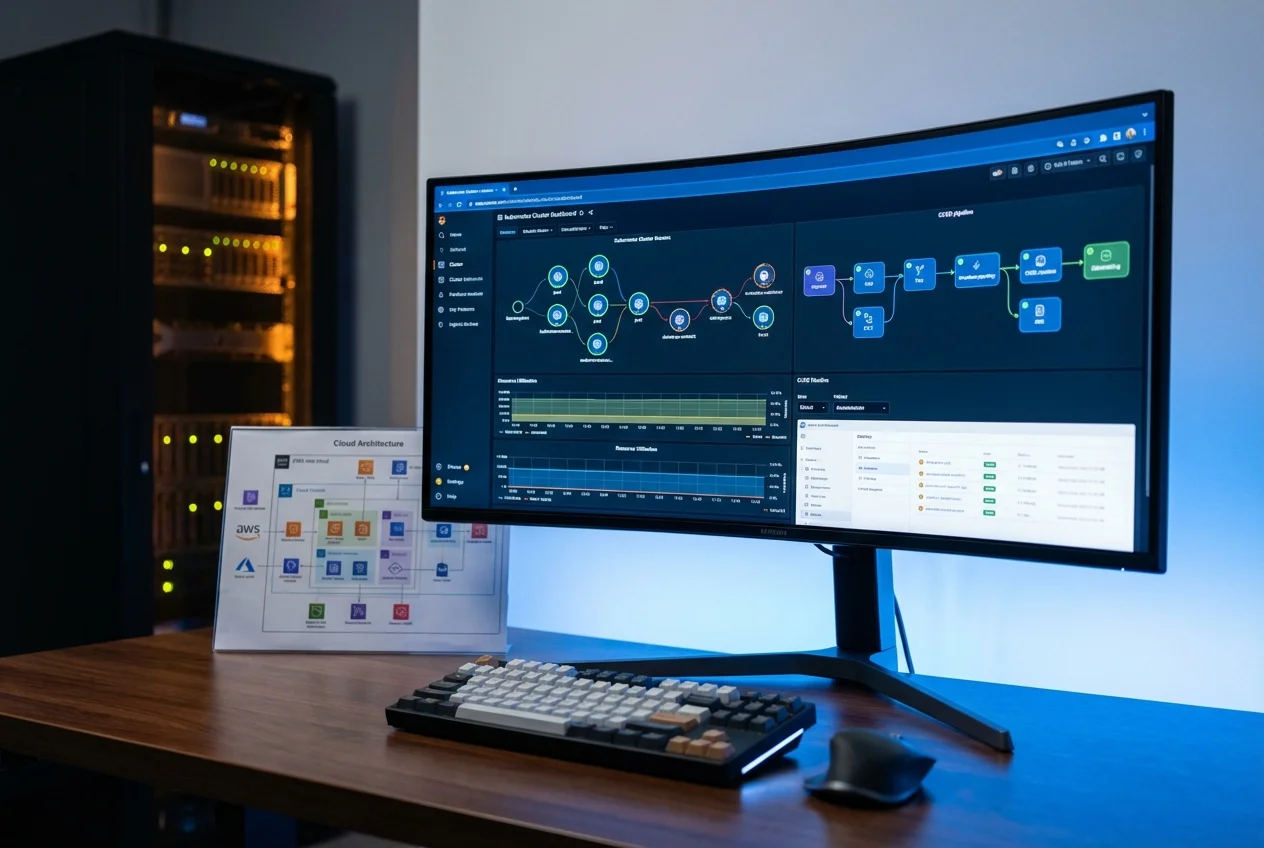
AWS-Optimised Infrastructure for SaaS Products at Scale
Running a data-intensive SaaS product on AWS is straightforward when you have ten users and a single RDS instance. It becomes an engineering discipline when you have thousands of tenants, terabytes of data, and an SLA that promises 99.95% uptime. The difference between a SaaS product that scales gracefully and one that melts under load is almost always in the infrastructure layer — how your containers are orchestrated, how your database handles read amplification, how your cache layer absorbs query spikes, and how your CDN serves assets globally without hammering your origin. We build AWS infrastructure specifically designed for the scaling patterns that SaaS products encounter in production.
AWS Service Selection for SaaS
AWS offers hundreds of services. Choosing the right combination for a SaaS product requires understanding which services deliver genuine value at each scale milestone and which ones add operational complexity without proportional benefit.
- ECS vs EKS Decision: We evaluate your operational maturity and scaling requirements to choose between ECS Fargate (simpler, fully managed, ideal for most SaaS products under 50 services) and EKS (full Kubernetes, appropriate when you need custom scheduling, service mesh, or have a team with Kubernetes expertise). We configure auto-scaling policies based on your actual traffic patterns — CPU, memory, or request-count based — rather than applying generic thresholds.
- RDS Architecture with Read Replicas: For read-heavy SaaS workloads (which most dashboard and analytics products are), we configure RDS PostgreSQL or Aurora with read replicas that absorb reporting queries, keeping the primary instance available for write operations. We implement connection pooling via PgBouncer and configure automated failover with Multi-AZ deployments so database maintenance windows do not mean downtime.
- ElastiCache as a Performance Multiplier: We deploy Redis via ElastiCache as a multi-purpose acceleration layer — session storage, API response caching, rate limit counters, and materialised view caching for expensive analytical queries. A well-configured cache layer typically reduces database load by 60-80% and cuts API response times by an order of magnitude for repeated queries.
- CloudFront CDN with Origin Shield: We configure CloudFront distributions with Origin Shield to collapse concurrent cache misses, custom cache policies per content type, and edge functions for header manipulation and A/B testing. For SaaS products serving users across the UK and EU, this reduces Time to First Byte from 200-400ms to under 50ms for cached content.
Deliverables
Every AWS infrastructure engagement produces a fully codified, documented, and monitored environment that your engineering team can operate and evolve.
- Terraform modules defining your complete AWS infrastructure with environment parity across dev, staging, and production
- ECS or EKS cluster with auto-scaling, health checks, and zero-downtime deployment configuration
- RDS PostgreSQL or Aurora with read replicas, automated backups, and Multi-AZ failover
- ElastiCache Redis cluster with eviction policies, persistence configuration, and replication
- CloudFront distribution with custom cache policies, Origin Shield, and edge function configuration
- CloudWatch dashboards and alarms covering latency, error rates, database connections, cache hit ratios, and cost anomalies
- AWS cost optimisation report with Reserved Instance and Savings Plans recommendations based on your usage patterns
When AWS Architecture Matters
Your SaaS product is running on AWS but your infrastructure was set up quickly during the early days and has not evolved as your product scaled. Your RDS instance is at 80% CPU during peak hours and you are not sure whether to scale up or add read replicas. Your cloud bill is growing faster than your revenue and you suspect you are paying for resources that are over-provisioned or unused. Or you are approaching enterprise sales conversations and your prospects are asking about your disaster recovery, data residency, and uptime guarantees — questions that require a properly architected AWS environment to answer honestly.
Why SaaS Development London for AWS Infrastructure
We hold AWS certifications and, more importantly, we have operated SaaS infrastructure on AWS in production for over a decade. We know which managed services genuinely reduce operational burden and which ones introduce hidden costs and complexity. We know that a t3.medium running PgBouncer can save you more money than a month of Reserved Instance planning. We know that ElastiCache cluster mode is unnecessary for most SaaS products under 100GB of cache data. This practical experience means we build infrastructure that is right-sized for today and straightforward to scale when your growth demands it.
If your AWS infrastructure needs a professional review, book a free infrastructure consultation and we will assess your current setup against SaaS best practices.
 Custom SaaS Development
 Web App Development
 API Development
 Mobile App Development
 Technical Consulting
 Figma to Code